Circularity and AI: What Do They Actually Have in Common?
Two industry studies, one uncomfortable truth: fashion and luxury are both being forced to become data companies
On paper, they look like two different conversations.
Circularity feels like a compliance story: regulation, waste, responsibility. AI feels like an innovation story: speed, personalization, growth. Different rooms, different people, different priorities, or so it seems.
So here's the provocative question: do circularity and AI actually have anything to do with each other — or are we just forcing two hot topics into the same sentence?
We looked at two of the most recent studies on the industry: one on circular fashion, one on AI in luxury, to find out, and the answer surprised us.
They're not parallel trends. They're the same problem, seen from two different rooms of the same building.
Room One: Circularity has a Data problem
KPMG's 2026 study is blunt about what's actually holding circular fashion back. It's not desire; 88% of the industry agrees circularity is now a strategic necessity, not a niche. It's not even technology, in the narrow sense. It's data.
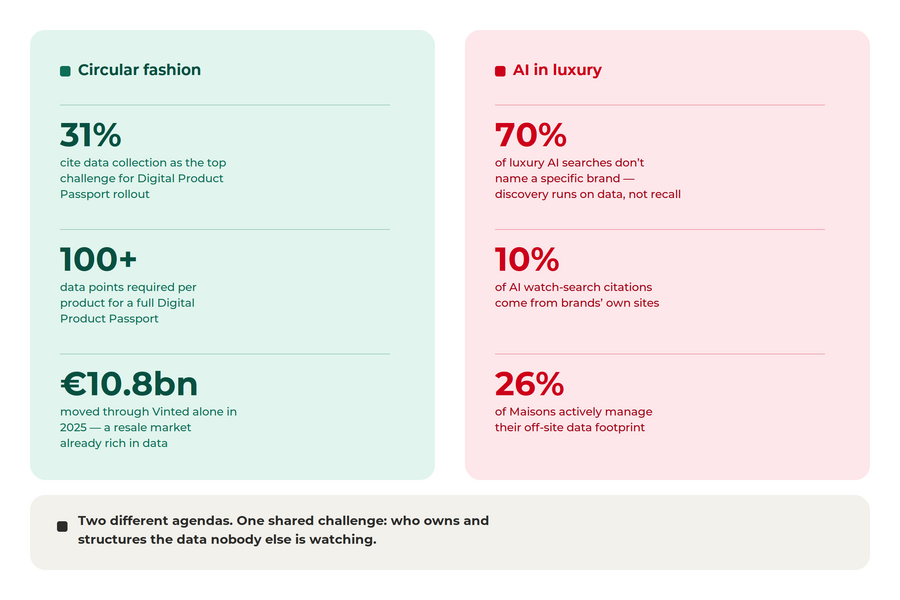
The Digital Product Passport, the EU's flagship tool for making garments traceable from fibre to end-of-life, is described as "a living, evolutive data infrastructure." Its entire value depends on being able to collect, structure, and act on information that today sits scattered across suppliers, tiers, and formats that don't talk to each other. Unsurprisingly, 31% of companies preparing for DPP implementation cite collecting data as their single biggest challenge, ahead of budget, technology, and leadership buy-in.
Read that again: the biggest obstacle to circular fashion at scale isn't regulation, or cost, or even consumer demand. It's the industry's inability to turn fragmented information into something usable.
That is not a sustainability problem. That is a Data Governance problem.
Room Two: Luxury has an AI Problem
Meanwhile, Bain's 2026 survey of luxury Maisons tells a strangely parallel story from the other side of the house. Luxury brands have finally put AI on the strategic agenda, 61% now rank it in their top 10 priorities, up from near-invisibility two years ago. But almost all of that energy is going into invisible AI: knowledge management, IT, procurement.
The customer-facing side remains deliberately, cautiously stalled.
And customers didn't wait. 64% of luxury buyers in China and 54% in the US already used AI during their last purchase, researching, comparing, styling, deciding, often without the brand even knowing it happened. The most valuable clients are the most enthusiastic: 82% of very heavy spenders used AI on their last purchase, versus 28% of light spenders.
The brands' own websites aren't even where this is happening. In unbranded AI searches, official brand domains account for only 10% of cited sources for watches and 45% for jewelry, third-party content is doing most of the talking. Luxury houses spent decades building tightly controlled brand narratives. AI search has quietly handed a chunk of that narrative to whoever has better, fresher, more structured data online.
Same Building, Same Foundation
Put the two studies side by side, and the pattern is unmistakable: both industries are being forced to become data companies, whether they choose to or not.
Circularity needs data to prove a garment is durable, repairable, recyclable, to make the invisible visible across a fragmented supply chain. AI-driven discovery needs data to make a brand findable, citable, and trustworthy across a fragmented information ecosystem. In both cases, the brands that win will be the ones that treat structured, high-quality data as a core asset, not a compliance afterthought bolted on for an auditor.
And this is where the two conversations stop being parallel and start being genuinely, practically the same conversation:
The DPP is an AI-ready asset before it's a compliance document. A Digital Product Passport that tracks material origin, repairability, and provenance isn't just built for a regulator; it's exactly the kind of structured, verifiable data that generative engines reward when deciding which brand to cite as "the reliable one" on a resale or sustainability query.
Resale and authentication are where circularity and AI already collide. Peer-to-peer platforms are moving over €10 billion a year in transaction value in Europe alone; AI-powered tools are already being used to price, authenticate, and route unsold inventory. The brands treating second-hand as a data-rich channel, not a leakage to manage, are the ones building the intelligence layer their competitors will eventually have to buy.
Forecasting is the quiet bridge between the two worlds. Better demand and inventory data doesn't just reduce overproduction (the raw material behind most of fashion's environmental impact), it's the same discipline that lets a brand personalize, plan, and respond at the speed AI-driven customers now expect.
The Real Provocation
Maybe the uncomfortable truth isn't that circularity and AI have nothing in common. It's that most fashion and luxury organisations are solving both problems separately, with separate teams, half-heartedly, at the same time, when, underneath, they are undergoing the same transformation: from an industry built on opacity and instinct to one built on structured, trustworthy, actionable data.
The companies that treat their circular economy data infrastructure and their AI strategy as two unrelated projects will keep finding both underwhelming. The ones that recognise they're building one foundation, not two, will move faster on both.
That's the intersection Deda Stealth was built to sit in: turning fragmented fashion and luxury data, resale, planning, and product into the intelligence brands need to be both circular and AI-ready, at the same time, with the same infrastructure.
Sources: KPMG & Fédération de la Mode Circulaire, "State & Prospects of Circular Fashion in Europe" (2026 Edition); Bain & Company / Comité Colbert, "Winning Over the Customer in the Age of AI: A New Horizon for Luxury" (2026).