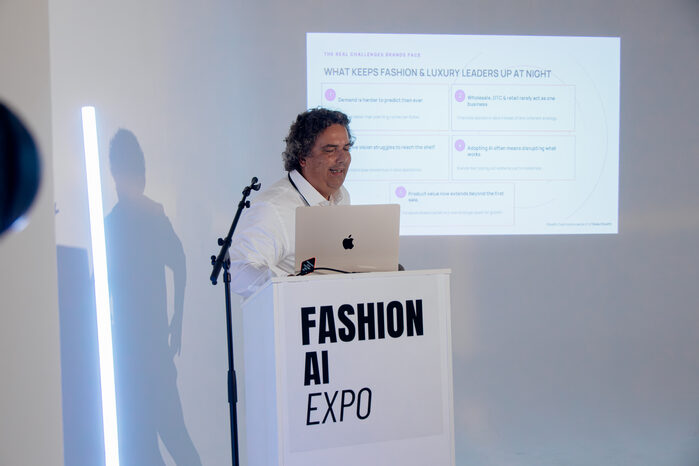
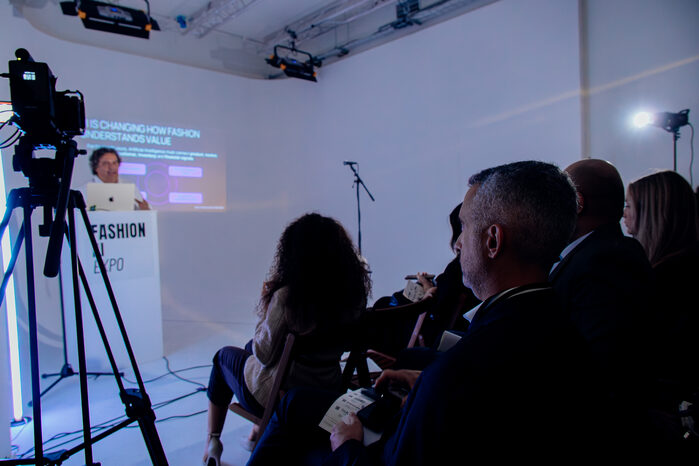
On 2 October 2026, the event Fashion AI Expo opened with a voice from fashion's operations rather than its studios. Luca Tonello, CEO of Deda Stealth, gave the day's first talk at Artistic Palace. His message to a room focused on creative AI was clear: the economics of a collection are decided backstage, long before a garment reaches the store window.
Tonello acknowledged the startups building creative AI, from generated campaigns to virtual models. Then he drew a line. Deda Stealth works on production, planning, and execution, a side of AI he described, with a smile, as "quite boring". Boring, but decisive. Operational excellence, he argued, is one of fashion's largest untapped opportunities, because that is where a collection's margins are set. He also pointed to a generational shift: young professionals who learned with an AI tutor will expect the same support at work, in the daily choices that put the right product in the right place at the right time.
One platform for the decisions that matter. The real obstacle is fragmentation. Planning, merchandising and finance often work in separate departments, on separate systems, without a shared view of the business. Deda Stealth's answer is to connect three moments on a single platform:
- Plan demand and budget
- Launch production
- Execute, allocating goods according to orders.
Everything rests on one shared inventory, so stock is placed by design rather than by chance. Without that view, he warned, online orders can be served first while stores are left empty. For any complex brand, with many markets, lines and channels, the central question becomes: what should we make, buy, allocate and replenish to achieve the strongest economic result? Answering it takes a new kind of software. Traditional ERPs are monolithic and complex; the new generation must be composable, solving one problem at a time, and AI-first, built on consistent data. "We don't want to put AI into existing systems," Tonello said. "We built a new platform based on AI."
That platform is Stealth Cosmica.
The most visible AI in fashion lives on screens and runways. The most consequential may live in allocation rules, replenishment plans, and resale flows, where every collection is decided a second time. For brands, the question is no longer whether to adopt AI, but where to start. Deda Stealth's answer: with the data, the people, and the decisions in between.